
 Login
Login
Ode to Napoleon Buonaparte op. 41. Verses 17–19
Katalogzettel
| Titel | Ode to Napoleon Buonaparte op. 41. Verses 17–19 |
| Spieldauer | 00:03:18 |
| Urheber/innen |
Schönberg, Arnold [Komponist/in]
[GND]
Byron, George Gordon Noel [Librettist/in] [GND] |
| Mitwirkende |
Jalowetz, Heinrich
[GND
]
Motorola [Label] |
| Datum |
1943 [Bezugsdatum] |
| Ort |
Asheville, Black Mountain College [Ortsbezug]
|
| Schlagworte | Musik ; E-Musik ; Publizierte und vervielfältigte Aufnahme |
|
20. Jahrhundert - 40er Jahre
|
|
| Typ | audio |
| Format |
SCS [Schallplatte, Schellack] |
| Sprache |
Englisch |
| Signatur | Österreichische Mediathek, e11-00541_b01_k02 |
| Medienart | Mp3-Audiodatei |
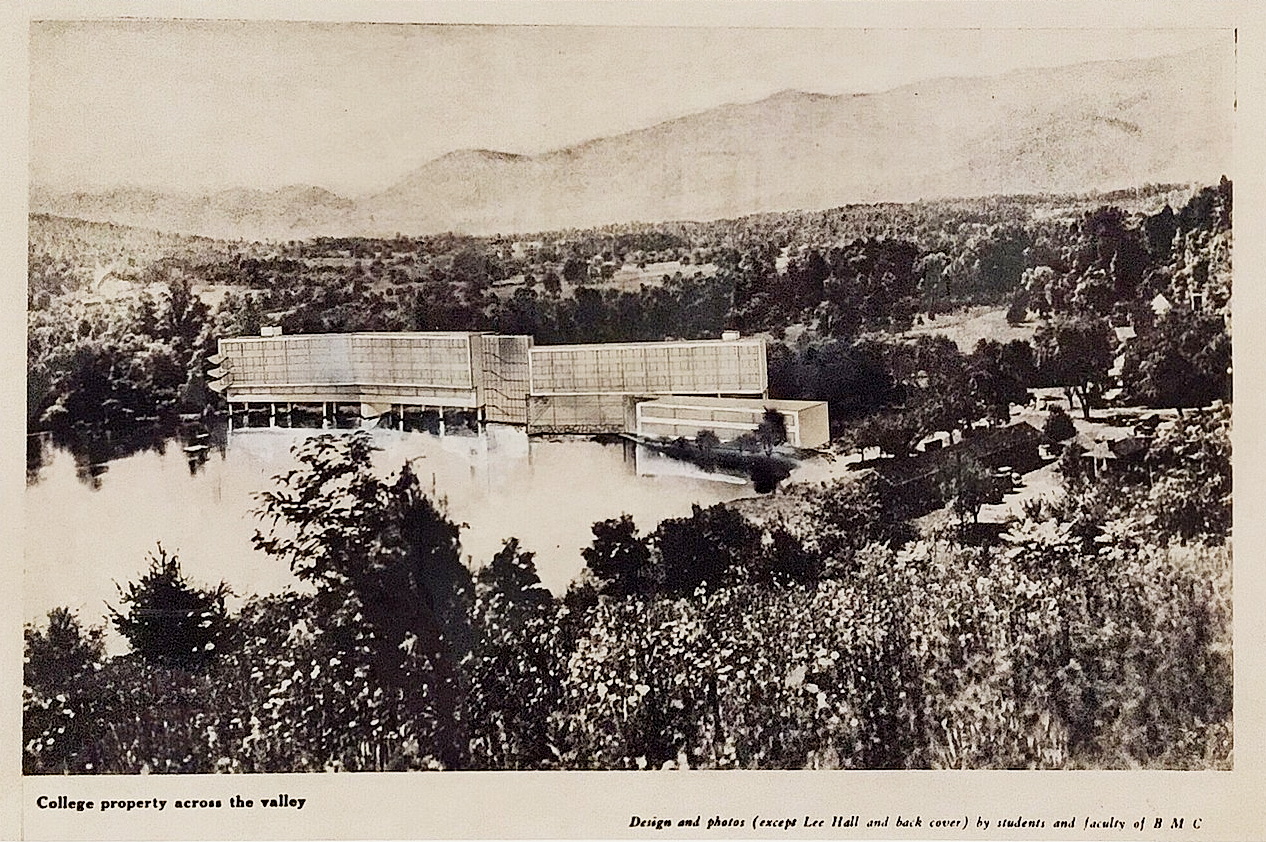
Drawing of planned campus building overlooking Eden Lake at Black Mountain College in Asheville, North Carolina (1938). Public Domain
Information
Inhalt
On August 4, 1943 Heinrich Jalowetz, Professor of Music at the Black Mountain College in North Carolina, wrote to his former teacher Schönberg: “Dear Friend, […] The shipment will not come as a surprise as originally planned, as it seems you have already heard that I am preparing a candidate for recitation of the ‘Ode to Napoleon,’ namely our young and multi-talented, highly intelligent history teacher Eric Bentley. Recordings were made as a preliminary result of our studies, which are now the contents of the aforementioned shipment.” Schönberg commented on the recording in detail: “From the records no such sonority emerges which shows whether [Mr. Bentley’s] voice has the compass (as to pitch and the number of shades) essential to express one hundred and seventy kinds of derision, sarcasm, hatred, ridicule, contempt, condemnation, etc., which I tried to portray in my music. [...] On the other hand I was astonished how well everything was done as regards rhythm and declamation. […] If I have to say what I think must be improved: very many parts are too slow. Especially these Allegros must be faster. And the Washington-section, which I give [quarter-note]=88 is at least a third too slow.” (Letter dated September 8, 1943)
Schönberg’s criticism refers to the final verse of the poem in which George Washington behaves antagonistically towards the dictator Napoleon, as a symbol of victorious democracy. In actual fact, Jalowetz and Bentley take the finish almost half as fast as marked in the score. It is likely that they were following the expression marking “Maestoso,” and less the tempo specified by the metronome marking. (Text: Arnold Schönberg Center)
Schönberg’s criticism refers to the final verse of the poem in which George Washington behaves antagonistically towards the dictator Napoleon, as a symbol of victorious democracy. In actual fact, Jalowetz and Bentley take the finish almost half as fast as marked in the score. It is likely that they were following the expression marking “Maestoso,” and less the tempo specified by the metronome marking. (Text: Arnold Schönberg Center)
