
 Login
Login
Chamber Symphony op. 9 (Beginning)
Katalogzettel
| Titel | Chamber Symphony op. 9 (Beginning) |
| Spieldauer | 00:04:10 |
| Urheber/innen |
Schönberg, Arnold [Komponist/in]
[GND]
|
| Mitwirkende |
Carvalho, Eleazar de [Dirigent]
Schatz, Oskar [Komponist/in] [GND ] |
| Datum |
1949.03.25 [Aufnahmedatum] |
| Ort |
New York, Juilliard School of Music [Ortsbezug]
|
| Schlagworte | Musik ; E-Musik ; Instrumentalmusik - Symphonie ; Besetzung - Kammerorchester ; Besetzung - Orchester ; Publizierte und vervielfältigte Aufnahme |
|
20. Jahrhundert - 40er Jahre
|
|
| Typ | audio |
| Format |
SCS [Schallplatte, Schellack] |
| Sprache |
Englisch |
| Signatur | Österreichische Mediathek, e11-00372_b01_k02 |
| Medienart | Mp3-Audiodatei |
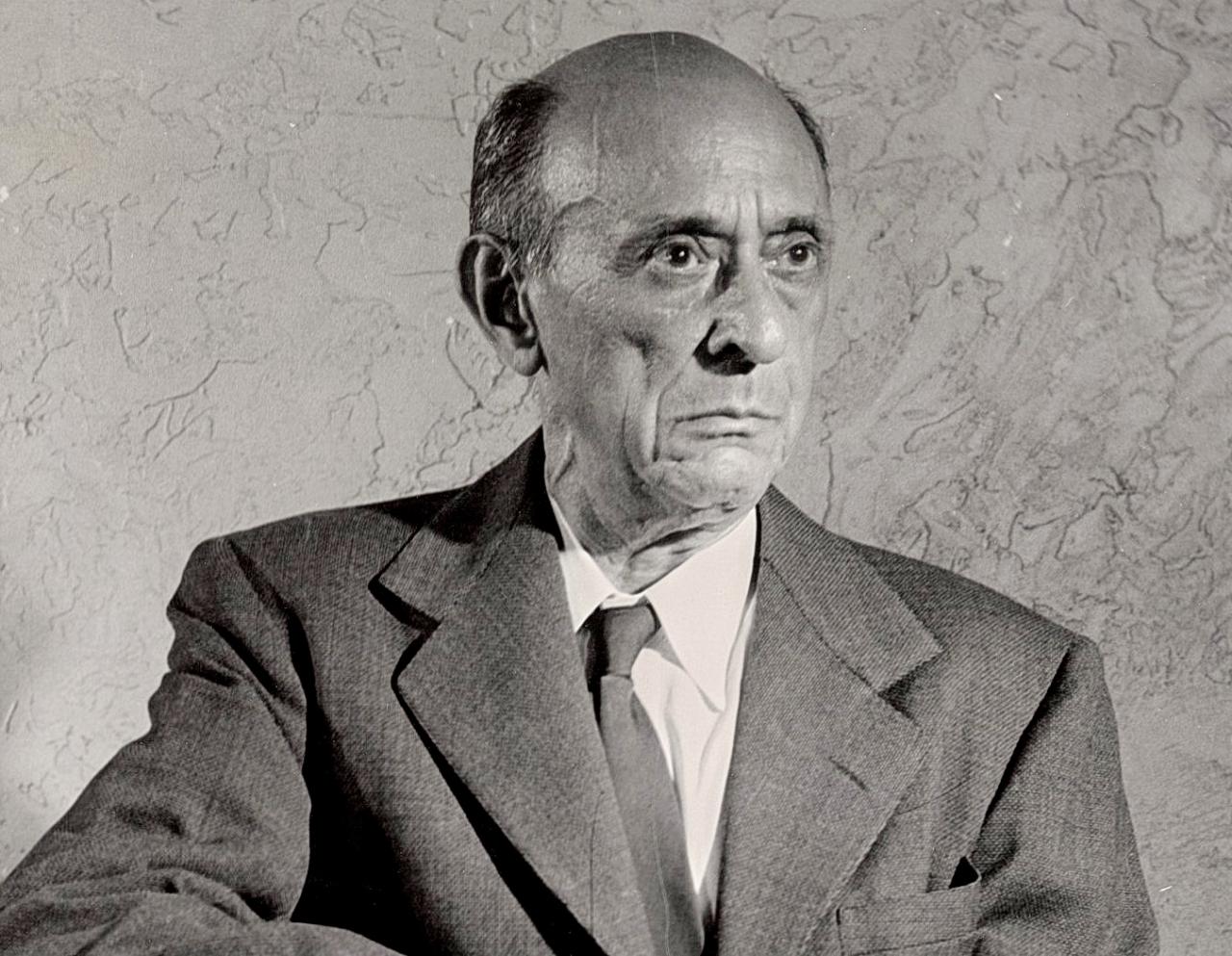
Arnold Schönberg, Alfred Carlson, Arnold Schönberg Center, CC BY-SA 3.0 AT
Information
Inhalt
On April 27, 1949 Arnold Schönberg’s assistant Richard Hoffmann wrote to composer and amateur photographer Alfred Carlson: “Mr. Schoenberg wants me to ask you whether you could make some copies – postcard size – of one of the excellent photographs you made of him […] He was asked for 16, by members of the Juilliard Orchestra who performed the Chamber Symphony.” The number of the prints ordered corresponded exactly to the number of instrumentalists for the work, plus conductor Eleazar de Carvalho. Several weeks later Schönberg wrote to the dean of the institution, Mark Schubart: “I cannot tell you how much I enjoyed the message of the 16 young musicians who played my Kammersymphonie and that they liked it so much […]. What I specially appreciate is that it is a really good omen for the future of my music.”
The phonograph recording received by Schönberg with the performance of the work on March 25, 1949 evidences the high standard of the performers. Compared to the recording from just 20 years earlier in Berlin, conducted by Fritz Stiedry, who underlines the melodic structure of the work with flexible phrasing, the Juilliard Orchestra plays accurately with relatively stable tempi. Even though the Austrian conductor’s approach to the performance of the work was closer to Schönberg’s own ideas, the composer appreciated the virtuosity and dedication of the young ensemble. (Text: Arnold Schönberg Center)
The phonograph recording received by Schönberg with the performance of the work on March 25, 1949 evidences the high standard of the performers. Compared to the recording from just 20 years earlier in Berlin, conducted by Fritz Stiedry, who underlines the melodic structure of the work with flexible phrasing, the Juilliard Orchestra plays accurately with relatively stable tempi. Even though the Austrian conductor’s approach to the performance of the work was closer to Schönberg’s own ideas, the composer appreciated the virtuosity and dedication of the young ensemble. (Text: Arnold Schönberg Center)
