
 Login
Login
Johannes Brahms: Piano Quartet G minor op. 25 (Arr. Arnold Schönberg)
Katalogzettel
| Titel | Johannes Brahms: Piano Quartet G minor op. 25 (Arr. Arnold Schönberg) |
| Spieldauer | 00:03:10 |
| Urheber/innen |
Brahms, Johannes [Komponist/in]
[GND]
Schönberg, Arnold [Bearbeiter/in] [GND] |
| Mitwirkende |
Klemperer, Otto [Dirigent]
[GND
]
Los Angeles Philharmonic Orchestra [Produzent] |
| Datum |
1938.05.07 [Aufnahmedatum] |
| Ort |
Wien, Zentralfriedhof, Ehrengrab Johannes Brahms [Ortsbezug]
Los Angeles [Aufnahmeort] |
| Schlagworte | Musik ; E-Musik ; Gesellschaft ; Besetzung - Orchester ; Besetzung - Quartett ; Instrumente - Klavier ; Unveröffentlichte Aufnahme |
|
20. Jahrhundert - 30er Jahre
|
|
| Typ | audio |
| Format |
SCS [Schallplatte, Schellack] |
| Sprache |
Englisch |
| Link |
Brahm's Piano Quartet in G minor on the website of the Arnold Schönberg Center |
| Signatur | Österreichische Mediathek, e11-00210_b01_k02 |
| Medienart | Mp3-Audiodatei |
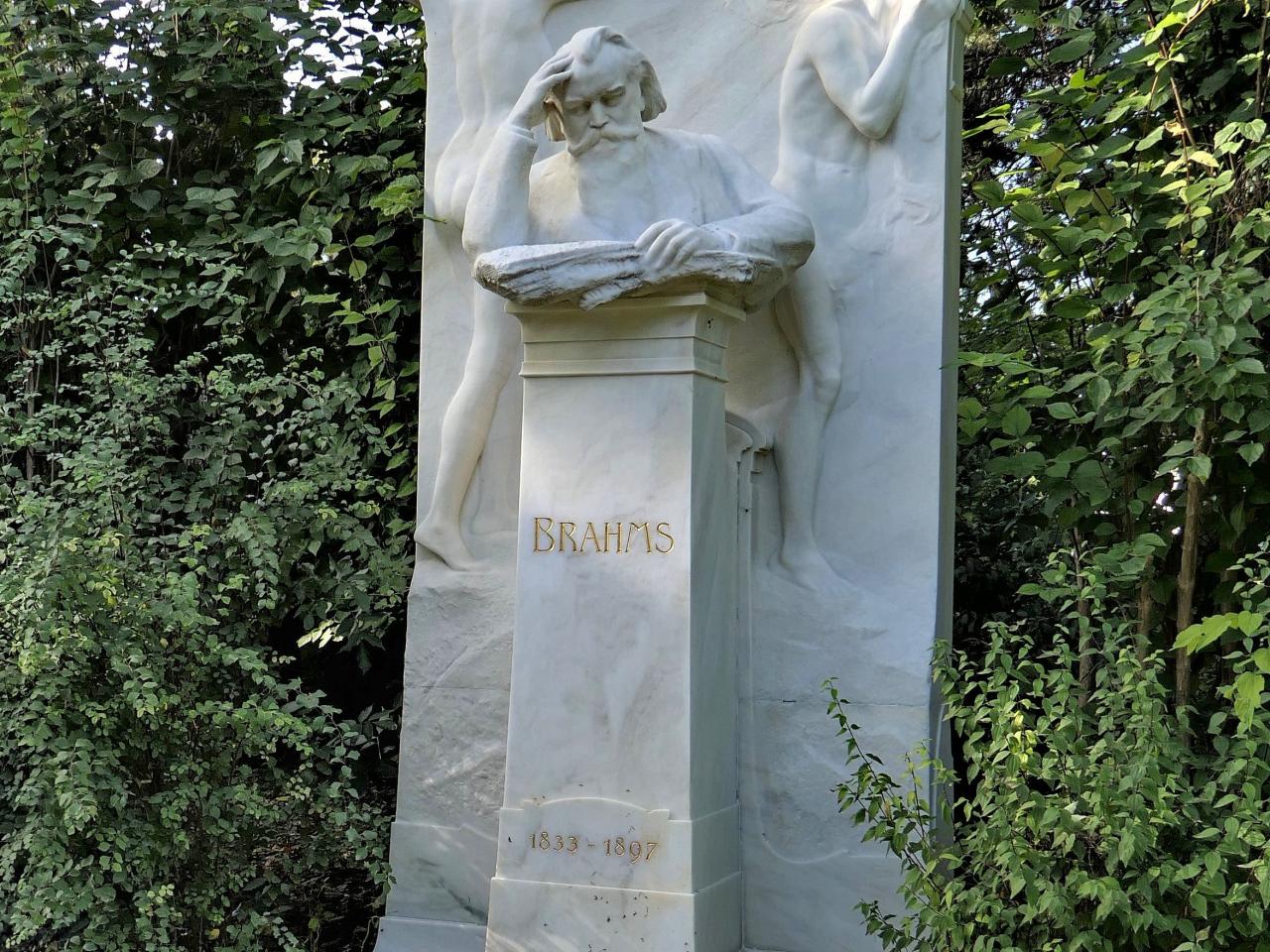
Johannes Brahms' grave, Wiener Zentralfriedhof, Bernd Gross, Public domain, via Wikimedia Commons
Information
Inhalt
As a self-taught musician, Arnold Schönberg was “exclusively Brahmsian” in his youth before his mentor and friend Alexander Zemlinsky motivated him to equally admire Wagner. In 1937 he wrote an orchestral arrangement of Brahms’ Piano Quartet in G minor. Otto Klemperer conducted the premiere on May 7, 1938 in Los Angeles.
In a letter to music critic Alfred V. Frankenstein dated March 18, 1939 Schönberg writes about his “intentions”:
“1. To remain strictly in the style of Brahms and not to go farther then he himself would have gone if he lived today.
2. To watch carefully all these laws which Brahms obeyed and not to violate [any of those] which are only known to musicians educated in his environment.
How I did it:
I am for almost 50 years very thoroughly acquainted with Brahms’ style and his principles. I have analysed many of his works for myself and with my pupils. I have played as violist and cellist this work and many others numerous times: I therefore knew how it should sound. I had only to transpose this sound to the orchestra and this is in fact what I did.
Of course, there were heavy problems. Brahms likes very low basses, of which the orchestra possesses only a small number of instruments. He likes a full accompaniment with broken chord figures, often in different rhythms. And most of these figures can not easily be changed, because generally they have a structural meaning in his style. I think I resolved these problems.” (Text: Arnold Schönberg Center)
In a letter to music critic Alfred V. Frankenstein dated March 18, 1939 Schönberg writes about his “intentions”:
“1. To remain strictly in the style of Brahms and not to go farther then he himself would have gone if he lived today.
2. To watch carefully all these laws which Brahms obeyed and not to violate [any of those] which are only known to musicians educated in his environment.
How I did it:
I am for almost 50 years very thoroughly acquainted with Brahms’ style and his principles. I have analysed many of his works for myself and with my pupils. I have played as violist and cellist this work and many others numerous times: I therefore knew how it should sound. I had only to transpose this sound to the orchestra and this is in fact what I did.
Of course, there were heavy problems. Brahms likes very low basses, of which the orchestra possesses only a small number of instruments. He likes a full accompaniment with broken chord figures, often in different rhythms. And most of these figures can not easily be changed, because generally they have a structural meaning in his style. I think I resolved these problems.” (Text: Arnold Schönberg Center)
