
 Login
Login
Johannes Brahms: Piano Quartet G minor op. 25 (Arr. Arnold Schönberg)
Katalogzettel
| Titel | Johannes Brahms: Piano Quartet G minor op. 25 (Arr. Arnold Schönberg) |
| Spieldauer | 00:04:27 |
| Urheber/innen |
Brahms, Johannes [Komponist/in]
[GND]
Schönberg, Arnold [Bearbeiter/in] [GND] |
| Mitwirkende |
Klemperer, Otto [Dirigent]
[GND
]
Los Angeles Philharmonic Orchestra [Produzent] |
| Datum |
1938.05.07 [Aufnahmedatum] |
| Ort |
Los Angeles, Philharmonic Auditorium [Ortsbezug]
Los Angeles [Aufnahmeort] |
| Schlagworte | Musik ; E-Musik ; Gesellschaft ; Besetzung - Orchester ; Besetzung - Quartett ; Instrumente - Klavier ; Unveröffentlichte Aufnahme |
|
20. Jahrhundert - 30er Jahre
|
|
| Typ | audio |
| Format |
SCS [Schallplatte, Schellack] |
| Sprache |
Englisch |
| Signatur | Österreichische Mediathek, e11-00209_b01_k02 |
| Medienart | Mp3-Audiodatei |
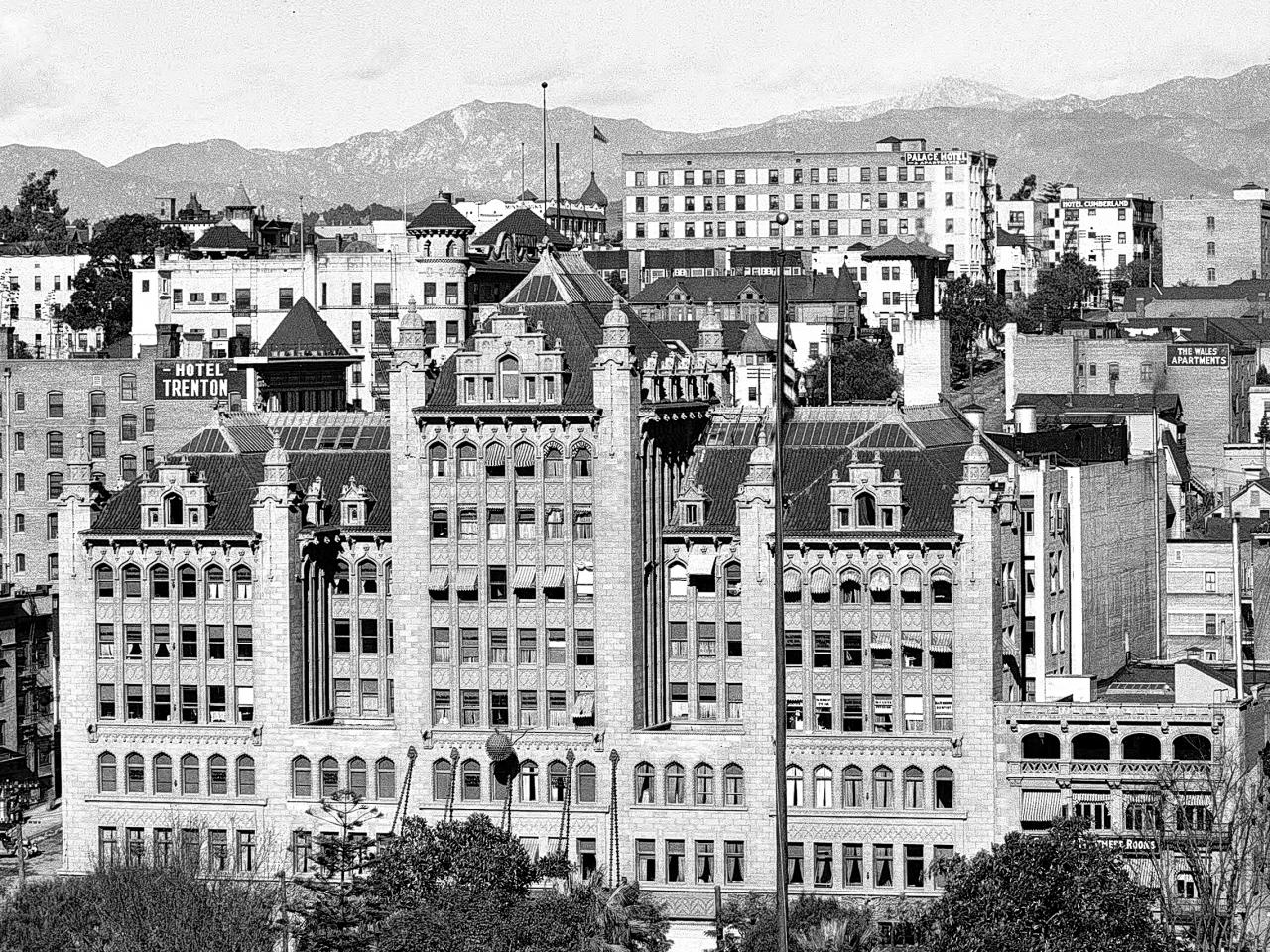
Philharmonic Auditorium, C. C. Pierce, Public domain, via Wikimedia Commons
Information
Inhalt
“With the Serenade for small orchestra, the Schoenberg orchestration of the G minor Piano Quartet and the Fourth Symphony, the Brahms Festival of six concerts directed by Otto Klemperer came to a close Saturday night. The Philharmonic Orchestra was in top form and the Philharmonic Auditorium crowded for the event. The concert marked the close of the Philharmonic winter season and the one hundred and fourth birthday of Johannes Brahms.
The orchestration of the G minor Piano Quartet enriched the world’s orchestral repertoire. It is so magnificent a work in the true spirit of Brahms that every conductor will want to add it to his music library and quite possibly use it as another Brahms symphony. The Rondo alla Zingarese was a thrilling experience as the virtuoso orchestra of Los Angeles played it for its first public performance. Arnold Schoenberg deserves an accolade for his monumental work. He put aside his own achievements in modern orchestration entirely and lost himself in Brahms.
Knowing that they were officiating at a history-making premiere, Klemperer and the orchestra played with an exuberance and a glow that was communicated to all listeners. Klemperer conducted the four-movement first performance without score and congratulated his orchestra at its brilliant conclusion.
The first three movements were logical and appropriate in every way but the exhilarating finale surpassed them. Flutist Linden, Concertmaster Gimpel, Cellist Porissoff and the busy percussion and xylophone players, all earned special glory.” (Isabel Morse Jones, Schoenberg Feat Hailed, in: Los Angeles Times, May 9, 1938) (Text: Arnold Schönberg Center)
The orchestration of the G minor Piano Quartet enriched the world’s orchestral repertoire. It is so magnificent a work in the true spirit of Brahms that every conductor will want to add it to his music library and quite possibly use it as another Brahms symphony. The Rondo alla Zingarese was a thrilling experience as the virtuoso orchestra of Los Angeles played it for its first public performance. Arnold Schoenberg deserves an accolade for his monumental work. He put aside his own achievements in modern orchestration entirely and lost himself in Brahms.
Knowing that they were officiating at a history-making premiere, Klemperer and the orchestra played with an exuberance and a glow that was communicated to all listeners. Klemperer conducted the four-movement first performance without score and congratulated his orchestra at its brilliant conclusion.
The first three movements were logical and appropriate in every way but the exhilarating finale surpassed them. Flutist Linden, Concertmaster Gimpel, Cellist Porissoff and the busy percussion and xylophone players, all earned special glory.” (Isabel Morse Jones, Schoenberg Feat Hailed, in: Los Angeles Times, May 9, 1938) (Text: Arnold Schönberg Center)
