
 Login
Login
Johannes Brahms: Piano Quartet G minor op. 25 (Arr. Arnold Schönberg)
Katalogzettel
| Titel | Johannes Brahms: Piano Quartet G minor op. 25 (Arr. Arnold Schönberg) |
| Spieldauer | 00:36:04 |
| Urheber/innen |
Brahms, Johannes [Komponist/in]
[GND]
Schönberg, Arnold [Bearbeiter/in] [GND] |
| Mitwirkende |
Klemperer, Otto [Dirigent]
[GND
]
Los Angeles Philharmonic Orchestra [Produzent] |
| Datum |
1938.05.07 [Aufnahmedatum] |
| Ort |
Los Angeles, Wohnhaus / residence Otto Klemperer [Ortsbezug]
Los Angeles [Aufnahmeort] |
| Schlagworte | Musik ; E-Musik ; Gesellschaft ; Besetzung - Orchester ; Besetzung - Quartett ; Instrumente - Klavier ; Unveröffentlichte Aufnahme |
| Örtliche Einordnung |
USA - Vereinigte Staaten von Amerika
|
|
20. Jahrhundert - 30er Jahre
|
|
| Typ | audio |
| Format |
SCS [Schallplatte, Schellack] |
| Sprache |
Englisch |
| Link |
Brahm's Piano Quartet in G minor on the website of the Arnold Schönberg Center |
| Signatur | Österreichische Mediathek, e11-00208_b02_k02 |
| Medienart | Mp3-Audiodatei |
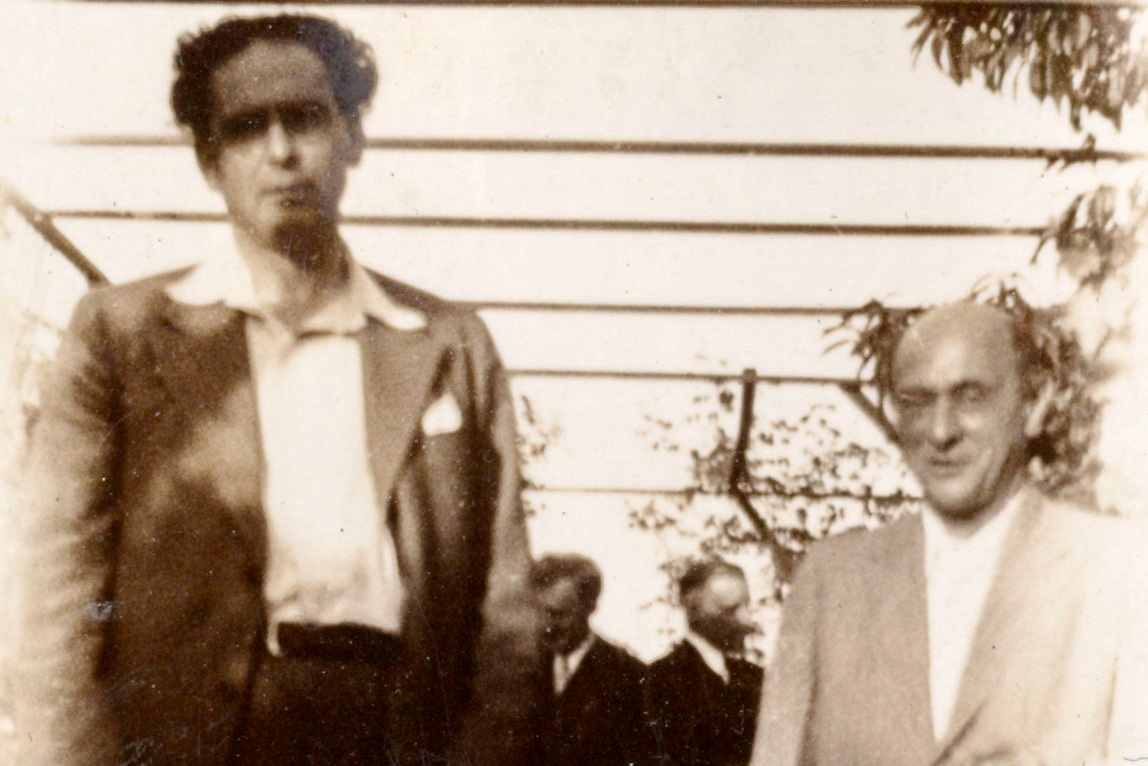
Otto Klemperer and Arnold Schönberg, Arnold Schönberg Center, CC BY-SA 3.0 AT
Information
Inhalt
Following a suggestion by conductor Otto Klemperer, Schönberg’s “posthumous” contribution to the symphonic music of Johannes Brahms was written between May 2 and September 19, 1937 in Los Angeles, which Schönberg occasionally referred to – jokingly and yet with a certain pride – as the “fifth symphony” of his great role model: the arrangement of Brahms’ Piano Quartet in G minor op. 25. The anthology “Conversations with Klemperer” (1974) edited by Peter Heyworth contains a significant comment by the conductor of the premiere: “The arrangement sounds so lovely, you won’t want to hear the original quartet again.” What sounds to dedicated Brahmsians like pure blasphemy and the negation of all boundaries by an arranger, is an act of confident reshaping for a large orchestra by Schönberg, even though the composer himself modestly – and also as an understatement – remarked: “I had only to transpose this sound to the orchestra and this is in fact what I do.” (Letter to critic Alfred Frankenstein dated March 18, 1939) Further information on his motivation for working on the composition is also provided: “1. I like the piece. 2. It is rarely played. 3. It is always played very badly because the better the pianist, the louder he plays, and you never hear anything from the strings. I just wanted to hear everything for once, and I managed it.” (Text: Arnold Schönberg Center)
