
 Login
Login
Symphonie Nr. 8 F-Dur op. 93
Katalogzettel
| Titel | Symphonie Nr. 8 F-Dur op. 93 |
| Titelzusatz |
Symphony No. 8, Beginning of the 2nd movement |
| Spieldauer | 00:03:55 |
| Urheber/innen |
Beethoven, Ludwig van [Komponist/in]
[GND]
|
| Mitwirkende |
Karajan, Herbert von [Dirigent]
[GND
]
Wiener Philharmoniker [Orchester] Columbia [Label] Columbia Graphophone Co. Ltd. [Produzent] |
| Datum |
1946 [Vermutliches Datum] |
| Ort |
Wien, Hofburg [Ortsbezug]
|
| Schlagworte | Musik ; E-Musik ; Instrumentalmusik - Symphonie ; Publizierte und vervielfältigte Aufnahme |
| Örtliche Einordnung |
Wien
|
|
19. Jahrhundert
|
|
| Typ | audio |
| Format |
SCS [Schallplatte, Schellack] |
| Sprache |
Englisch |
| Signatur | Österreichische Mediathek, 2-01775_a_b01_k02 |
| Medienart | Mp3-Audiodatei |
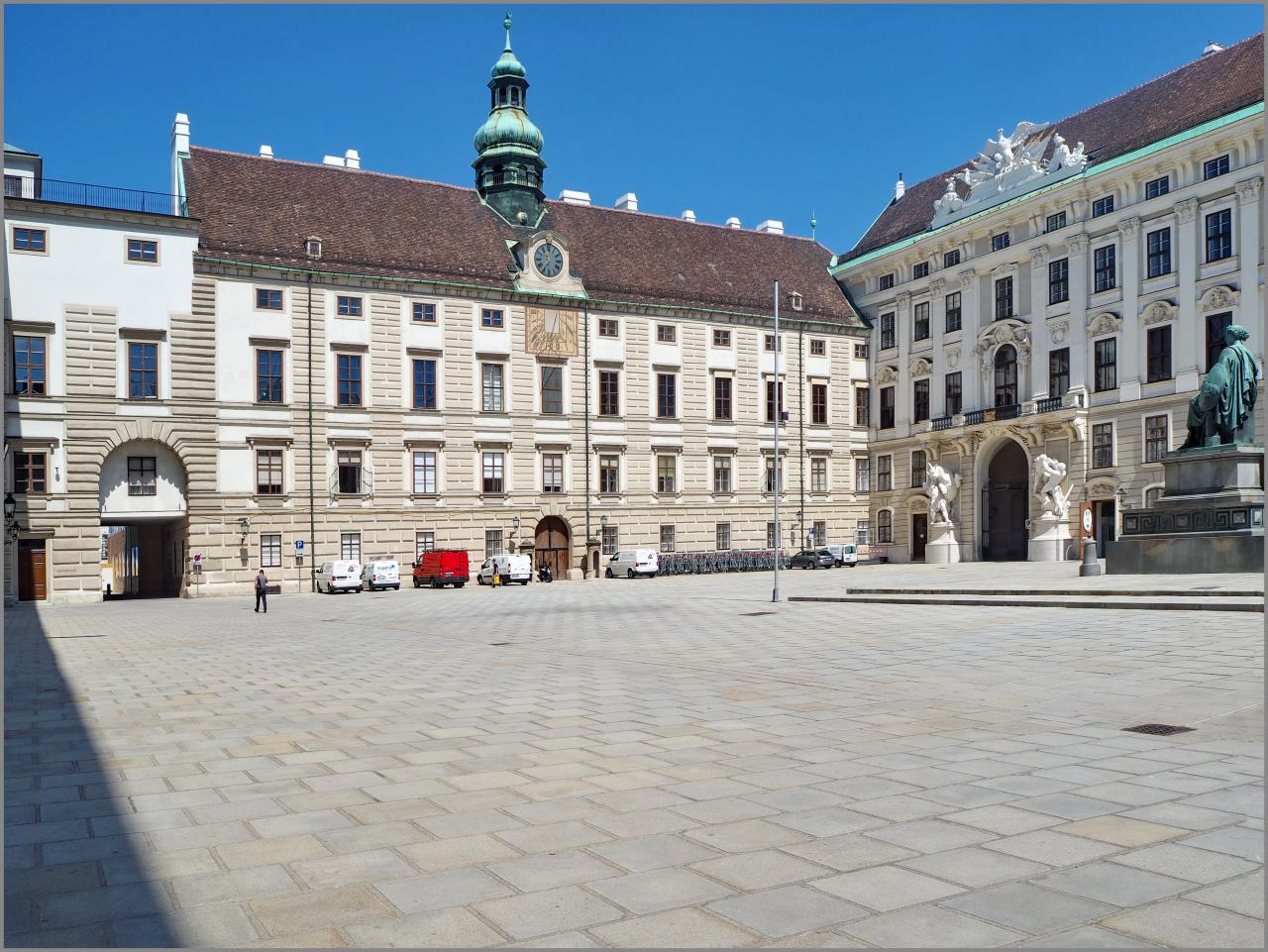
Wiener Hofburg. Bild: CC BY-SA 3.0 AT. Österreichische Mediathek 2020.
Information
Inhalt
Beethoven had originally planned to perform the Eighth Symphony together with the Seventh Symphony at a charity concert. In early 1813 he abandoned the idea for financial reasons. As he wrote to his patron Archduke Rudolph, “The need to keep myself alive now dictates a change of plan.” After receiving this letter, the Archduke made arrangements for a rehearsal of the two symphonies in his rooms at the Hofburg, in preparation for a recital (or academy) that would generate income for Beethoven. The event itself did not take place until 1814.
The second movement of the Eighth Symphony, here on a 1946 recording by the Vienna Philharmonic under Austrian conductor Herbert von Karajan (1908–1989) became especially well-known. The story that the dominant metrical accompaniment was intended as a parody of the metronome, which had recently been invented by Johann-Nepomuk Mälzel, has now been disproved, but this does not rule out the possibility that the composer was indulging in a musical joke in this movement, in which he plays mischievously with the conventions of the time.
Karajan owed his meteoric rise on the international classical music scene in no small part to his talent for self-promotion, which he combined with support from British label Columbia. Karajan made no fewer than five recordings of Beethoven’s complete symphonies, as well as of individual works.
(Constanze Köhn)
The second movement of the Eighth Symphony, here on a 1946 recording by the Vienna Philharmonic under Austrian conductor Herbert von Karajan (1908–1989) became especially well-known. The story that the dominant metrical accompaniment was intended as a parody of the metronome, which had recently been invented by Johann-Nepomuk Mälzel, has now been disproved, but this does not rule out the possibility that the composer was indulging in a musical joke in this movement, in which he plays mischievously with the conventions of the time.
Karajan owed his meteoric rise on the international classical music scene in no small part to his talent for self-promotion, which he combined with support from British label Columbia. Karajan made no fewer than five recordings of Beethoven’s complete symphonies, as well as of individual works.
(Constanze Köhn)
